In the AI industry, the cult of “Big Data” is being replaced by a more sophisticated philosophy: Data-Centric AI. It turns out that feeding a model redundant, standard examples is like asking a grandmaster to solve basic addition. There is plenty of practice, but zero growth.
True intelligence is born where patterns end and “Black Swans” rare, boundary, and structurally complex events begin.
The Trap of Predictability: Why Models Stop Learning
To understand how AI learns, we have to look at the Error Gradient.
Think of a neural network as a system of billions of “levers” (weights). Training is the process of adjusting these levers until the output is correct.
- The Pattern Trap: When a model sees a typical example, its prediction aligns perfectly with reality. The “Loss” (error) is near zero. Since there is no error, the algorithm decides nothing needs to change. The levers stay put. The model isn’t learning; it is just confirming what it already knows.
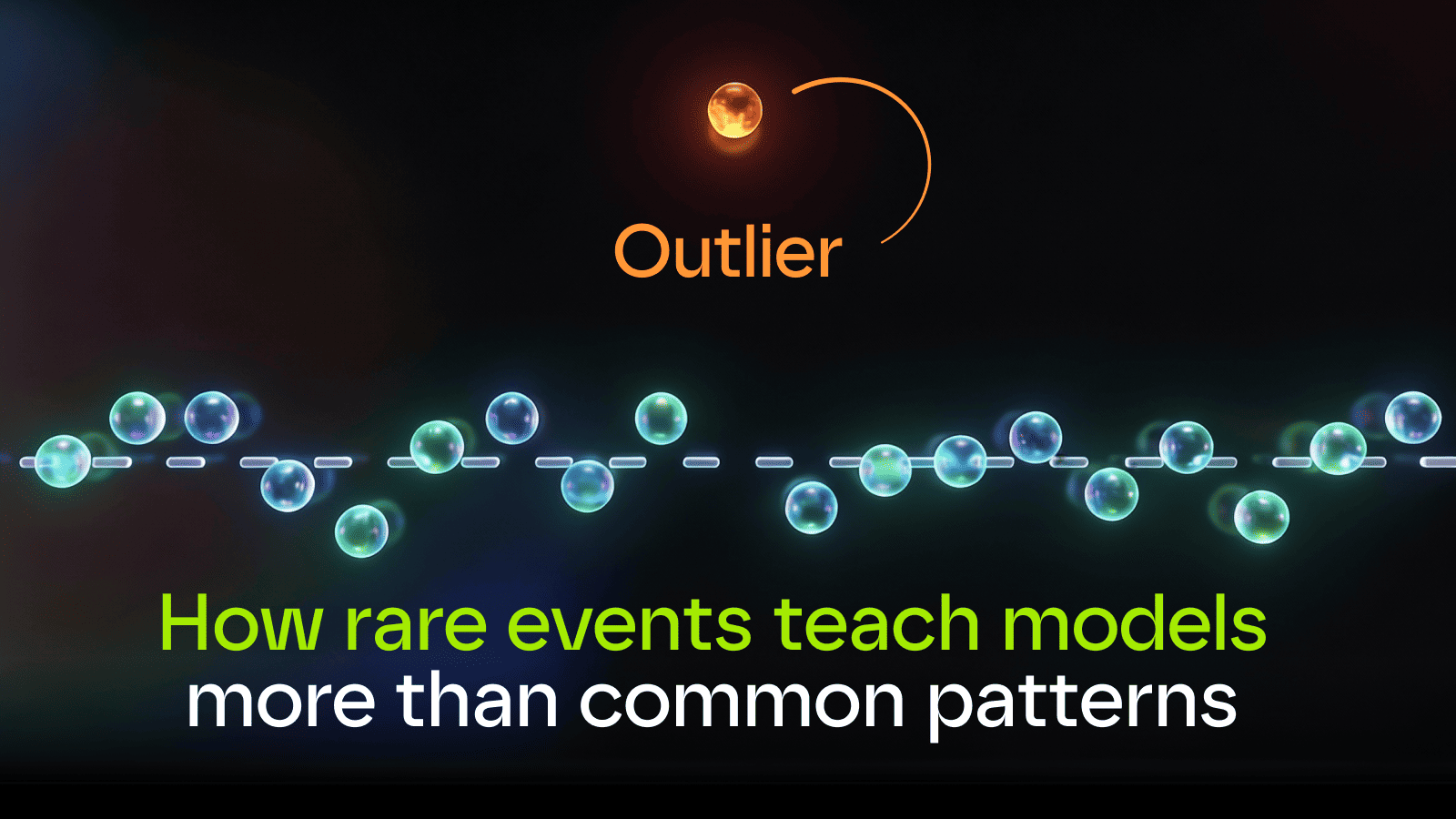
- The Anomaly Spike: A rare event creates a massive error. This sends a high-voltage signal through the Backpropagation algorithm. This shock forces the system to recalculate connections even in the deepest layers of the network.
The takeaway: A rare event is the only moment a neural network truly wakes up and evolves.
Decision Boundaries: Mapping the Edge of Reason
In machine learning, the Decision Boundary is the invisible line in the model’s mind that separates one concept from another.
Imagine a map where thousands of dots representing “Safe Driving” are on one side and “Collision” on the other. If you only provide the model with “clean” data, it will draw a very crude, straight line between them.
However, if you add Edge Cases (those rare dots that sit right on the fence), the AI is forced to draw a surgical, nuanced boundary.
- Rare events act as anchors that map the complex landscape of reality.
- Without them, a model remains “brittle.” Any slight deviation in the real world will cause a catastrophic failure because the model never learned where the true limits lie.
The Long Tail and the Robustness Problem
The real world does not follow a simple bell curve; it lives in the Long Tail.
- The Head: Common situations that make up 95% of data.
- The Tail: The 5% of rare cases such as extreme weather for autonomous vehicles, rare medical pathologies, or hyper-specific linguistic dialects.
The irony of AI is that mistakes in that 5% “tail” are often the most expensive or dangerous. If a model has not seen the tail during training, it lacks robustness (the ability to remain stable in chaos). A high-quality dataset should not just be large; it must be mathematically balanced so the model treats rare cases with the same gravity as the norm.
From “Big Data” to “Smart Data”: The DataHive AI Perspective
For companies building SOTA (State-of-the-Art) models, the focus has shifted from raw volume to Data Curation. Raw data scraped from the web is often saturated with noise and “empty calories” (redundant information that adds no value to the gradient).
At DataHive AI, we bridge the gap between raw information and model intelligence. The value of a modern dataset lies in:
- Identifying High-Entropy Examples: Finding the specific Edge Cases that actually force a model to improve.
- Precision Labeling of Anomalies: Ensuring the model understands the “why” behind the exception, not just the rule.
- Balancing the Distribution: Artificially augmenting the “Long Tail” so that models are prepared for the 1% of events that matter most.
Summary
A model’s intelligence is not measured by how many patterns it can repeat, but by its accuracy at the points of maximum uncertainty. One professionally curated dataset with a high concentration of “hard” examples is more effective than a petabyte of uniform logs.