Why off-the-shelf — and even frontier — ASR fails on Arabic dialects, and what a targeted corpus fixes.
Generic speech-to-text — and even much larger or paid systems — breaks down on dialectal, emotional Arabic. We show the fix is data, not model size: a targeted 4-dialect corpus, added to public data, roughly halves error on the covered dialects, with a controlled ablation isolating the corpus as the cause — and the gain is largest exactly where off-the-shelf models are weakest. We benchmark honestly against Meta’s 7B omniASR and the Deepgram API: on the speech we serve, our model leads; on generic data, frontier systems are competitive. The differentiator is the right data plus rigorous, non-cherry-picked evaluation.
The problem: where Arabic ASR breaks
Arabic ASR is not one problem. Modern systems handle Modern Standard Arabic (MSA) — broadcast, formal speech — reasonably well. They fail on spontaneous, dialectal, emotional speech, which is most of how people actually talk. Three things make it hard:
Distance from MSA. Dialects like Moroccan Darija diverge sharply from MSA in vocabulary, morphology and phonology; MSA-trained models have little to draw on.
No standard orthography. Dialects have no agreed way to be written. The same word is spelled several ways, and clitics (و/ب/ال) agglutinate onto words. This wrecks word-level error metrics (§6).
Emotion shifts the acoustics. Angry, sad or happy speech changes rate, pitch and articulation — further off-distribution for models trained on neutral, read speech.
On our held-out target test (proprietary, speaker/script/text-disjoint), stock Whisper-large-v3 scores WER 0.589 / CER 0.226 — unusable for production. On Moroccan Darija it is far worse.
The corpus: built to test the hypothesis
To find out whether targeted data — not a bigger model — is what closes the gap, we needed speech that off-the-shelf systems have never seen and that public datasets simply do not cover: dialectal, emotional, conversational Arabic. So we built it ourselves. Through DataHive’s data-collection platform we recruited native speakers of each target dialect and ran a structured recording pipeline — scripted prompts across ten everyday domains (customer service, healthcare, finance, education, travel, emergency, family, daily life, shopping, technology), each performed in four emotional registers, with multiple takes and per-clip quality control.
The result is our proprietary 4-dialect × 4-emotion corpus — native-speaker recordings balanced across emotions and ten everyday domains, spanning 11,000+ distinct scripts, with speaker-, script-, and text-disjoint splits so the numbers later in this paper measure genuine generalization to unseen speakers and sentences, not memorization. And because it comes from a repeatable collection platform rather than a one-off dataset, it is an asset we extend to new dialects, domains, and emotions on demand — the coverage grows to fit the use case.
The approach: it’s the data, not the model
We fine-tune Whisper-large-v3 with LoRA on a data mixture, and run a controlled ablation to isolate what drives quality. Two recipes differ by exactly one thing:
Recipe A — public only: open Arabic datasets (SADA + MASC).
Recipe B — public + ours: the same public data plus our proprietary 4-dialect × 4-emotion corpus.
The public mixture is held byte-identical between A and B, so any A→B difference is our corpus, nothing else. Every model is scored on the same held-out target test — only the training data changes.
Results: the corpus is the driver
Headline, target test, leaderboard normalizer:
Model
WER
CER
Stock Whisper-large-v3
0.589
0.226
Public-only fine-tune (A)
0.598
0.204
+ our corpus (B)
0.258
0.077
Public data alone does not solve the dialectal problem — adding more public Arabic (A) leaves word error at stock and only trims character error modestly. On the target domain the corpus is what moves the needle: B cuts WER by 56% and CER by 66% versus stock, and the corpus contribution itself — B − A, public mix held identical — is large and significant on every dialect (overall −0.127 CER / −0.340 WER; −0.094 / −0.226 under CAMeL). This is a target-domain result — §5 shows it does not hold on neutral, out-of-domain Saudi data.
The value of targeted data scales with where models fail
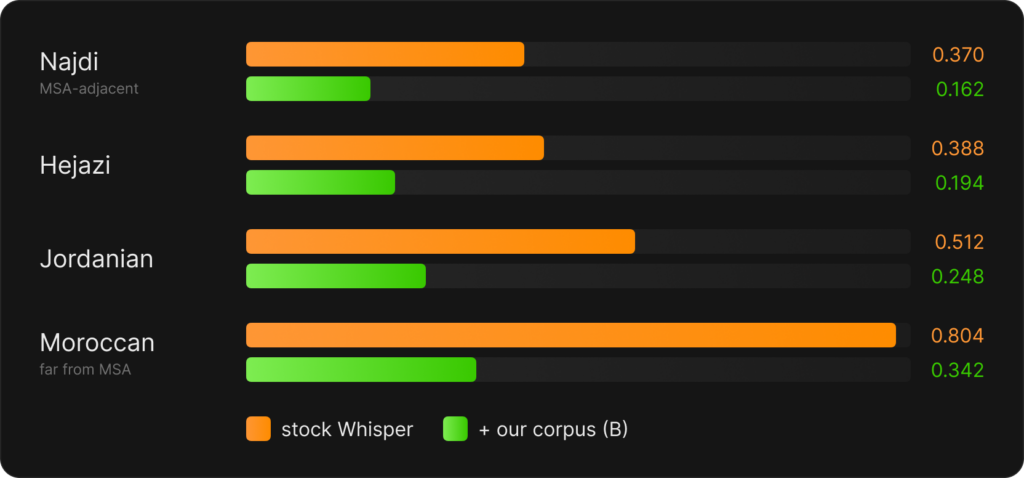
Target-test WER by dialect (lower = better). The corpus’s biggest wins land on Moroccan Darija — exactly where off-the-shelf collapses — and smaller wins on the MSA-adjacent Saudi dialects, where stock is bad but not catastrophic. Note the overall figures are micro-averaged and Moroccan + Najdi are 77% of the clips; the unweighted macro-average is a touch milder (stock WER 0.519 → B 0.237, −54%).
How we stack up against the field
We compared our corpus-tuned model against two strong baselines on the same target test: Meta’s omniASR-LLM-7B (a 7-billion-parameter open model) and Deepgram (a commercial paid API with dialect-specific Arabic models).
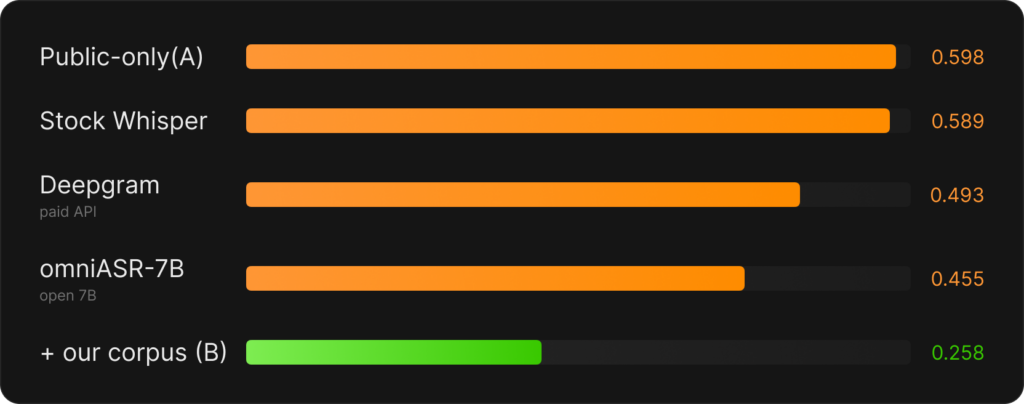
Overall WER on our target test — vs the field
Both baselines beat stock Whisper — omniASR-7B and Deepgram are genuinely strong — yet our corpus on plain Whisper beats them by a wide margin (overall −0.198 WER vs omniASR, significant).
Deepgram is a competent Arabic recognizer, but on our domain the corpus-tuned model cuts its error on every dialect by roughly a third to a half depending on dialect and normalizer (about −36% overall on CER under the convention-robust metric, up to ~50% on the leaderboard metric).
The honest caveat: domain, not universal superiority
This is the speech we serve — our dialects, our convention. Step outside it and the wins narrow or vanish, and we report that plainly:
Neutral third-party data (Meta’s public Omnilingual). The corpus advantage concentrates the same way — large on Moroccan (B CER 0.219 vs stock 0.398, CAMeL) — but near-zero on MSA-adjacent Saudi: under the convention-robust metric public-only training (A) matches or slightly beats the corpus (B) there, and B’s edge over stock is small.
External Moroccan. We beat omniASR-7B on adiren7 (YouTube Moroccan), but lose to it on MDER-MA — another external Moroccan set — by a wide, significant margin (B CER 0.660 vs 0.514, CAMeL), and roughly tie it overall on the neutral Casablanca benchmark (a shade behind on its Moroccan subset). The corpus makes Whisper better on our Moroccan speech, not Moroccan in general.
Our advantage is specialization for the target use case, not a universally better Arabic model. Saying so plainly is the point (§6).
How we measure (and why you can trust it)
Dialectal Arabic ASR is unusually easy to measure badly. We make three deliberate choices.
We report CER, not just WER. Because dialects agglutinate clitics and have no standard spelling, word-level WER swings with segmentation and orthography, while character-level CER is robust. We report both and read CER as the trustworthy signal.
We account for orthographic convention. Each system writes its own spelling. Scored against references in our convention, our model has a home advantage; against a third party’s convention it is penalized. Re-scoring under a convention-robust normalization (CAMeL-standard) shows that a sizable part of any model’s apparent lead is spelling, not quality — and the effect cuts both ways.
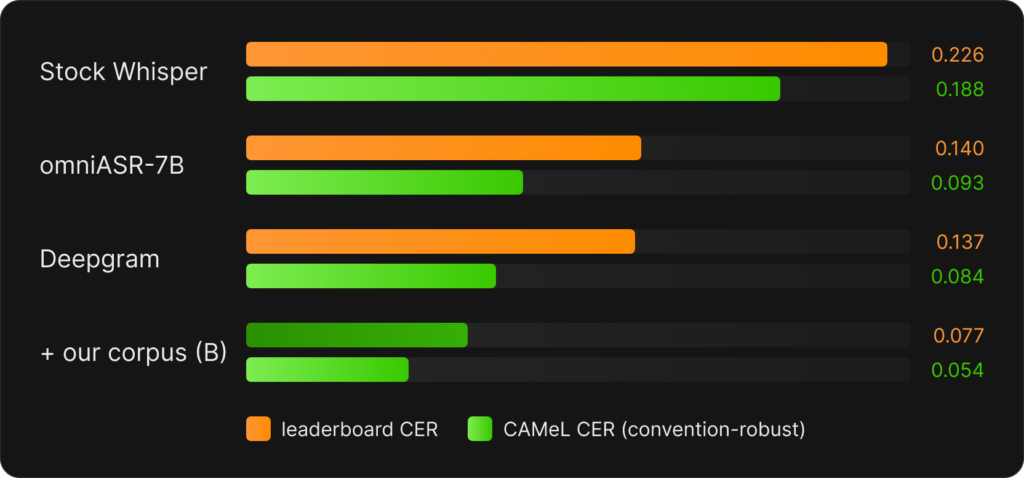
Under a stricter, convention-robust metric — the lead shrinks but holds
Overall CER. Everyone’s number drops once spelling is folded away — but the ranking holds and B stays lowest. Our CER lead over omniASR-7B goes from −0.063 to −0.039 (still significant); over stock it barely moves (−0.149 → −0.134): that gap is real quality, not orthography.
We don’t cherry-pick. We report the comparisons where we win and the ones where we don’t, under more than one metric and normalizer. For a buyer evaluating a vendor, that transparency is the signal: the numbers are real.
What this means for you
If your use case is dialectal or emotional Arabic, off-the-shelf and even paid/frontier ASR will under-deliver — most on the hardest dialects.
Targeted data is the moat. A well-collected, on-target dialectal corpus produces gains that model size and mountains of public data do not — quality and targeting, not raw volume, move the needle.
The gain is measurable and targeted: it is largest on the dialects the corpus covers, and concentrated where generic models are weakest.
DataHive brings both the proprietary data and a rigorous, honest evaluation method to prove the lift on your domain.
Appendix — methodology & notes
Model: Whisper-large-v3 + LoRA (PEFT). Corpus share 40% of the training mixture.
Ablation: Recipe A redistributes the corpus slot to public data, holding the public mix byte-identical to B; the only variable is our corpus.
Test: held-out, speaker + script + text-disjoint; ~3,354 clips across four dialects. Headline “overall” figures are micro-averages over clips (Moroccan + Najdi are 77% of the test); we also report the 4-dialect macro-average, which is less sensitive to the speaker mix.
Metrics: WER + CER under the Open Universal Arabic ASR Leaderboard normalizer and a CAMeL-standard convention-robust normalizer; 95% CIs from paired bootstrap.
Baselines: stock Whisper-large-v3; public-only fine-tune; Meta omniASR-LLM-7B; Deepgram. External models are not scored on the Omnilingual dialect sets (omniASR’s own training data). Decoding note: Deepgram was given dialect-specific language codes (ar-SA / ar-JO / ar-MA); omniASR-7B ran through its standard fairseq2 pipeline without per-clip dialect language hints — a variable we did not fully control.